
Ready to cut down on sugar?
A natural monk fruit sweetener for coffee, breakfast and baking. No erythritol, so none of the cooling sensation those blends are known for, and 2 kcal a serving.
What is inside: 70% soluble tapioca fibre, 30% monk fruit decoction. We print the full proportions because you should know exactly what you are buying.
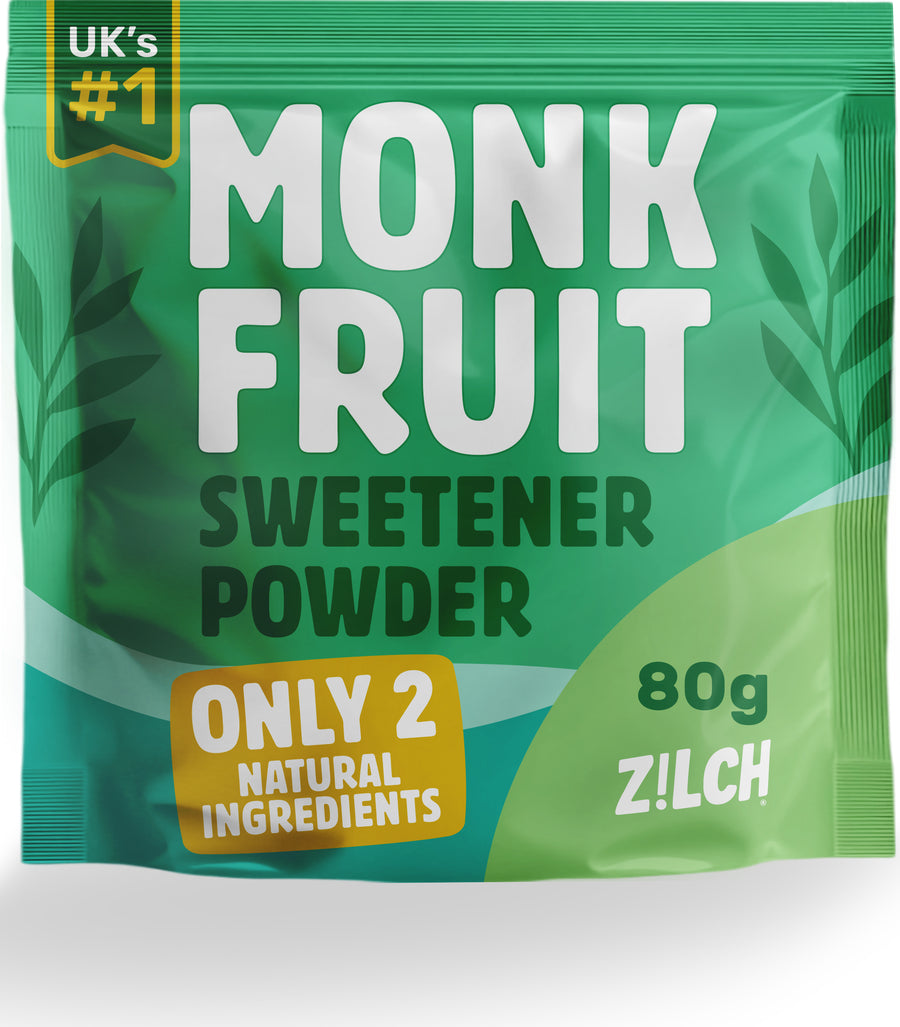





What Zilch actually is
Zilch is made from the whole monk fruit rather than a purified extract of it, with soluble tapioca fibre as the only other ingredient. Two things in the pouch. Here is what that changes day to day.
It dissolves cleanly into hot and cold drinks, and there is no cooling sensation, which is the thing erythritol blends are known for.
You cut the sugar without giving up the sweetness. It is around 3 times sweeter than sugar, so you use noticeably less.
Porridge, yoghurt, smoothies, dressings and baking, wherever it is sweetness you want rather than sugar's bulk.
 Gluten Free
 Vegan Friendly
 Nut Free
 Keto Friendly
 Gut Friendly
 All Natural
The whole ingredients list
No erythritol, no allulose, no artificial sweeteners, no bulking agents beyond the carrier that makes it a powder.
A gentle water infusion of the whole fruit, known technically as a decoction, slowly simmered to draw out its natural sweetness and then dried. Not a purified extract, which is why the sweetness tastes rounded rather than sharp.
Turning a liquid infusion into a powder needs a carrier. Most brands use erythritol. We use a well-tolerated prebiotic fibre instead, which is why there is no cooling sensation and nothing from the sugar alcohol family in the pouch.
What it tastes like, what is in it
Two ingredients. No erythritol, no sugar alcohols, no artificial additives.


In their words
Real reviews from Amazon UK buyers. We have not tidied them up. 3.8 out of 5 from 206 reviews.
Absolutely the best sweetener available, blown away by the taste, I used to use a stevia and erythritol blend before, which caused some tummy issues after, but this had no such effect
Fantastic product. First time using this in anything other than tea / coffee. I baked a cake and it tasted amazing. Really sweet which can be tasted through out the sponge. I will absolutely be purchasing again. Highly recommend.
Does the job, no weird after taste for me personally, as some have mentioned. Using it in baking and cooking in general. Works well as a sugar substitute.
It has a lovely sweetness without the usual overpowering aftertaste. It dissolves easily into drinks and recipes. A little goes a long way so it’s great value too. I’ll definitely buy it again!
Great product! Super sweet so you only need a small amount to get the desired taste. It’s a really healthy alternative to sweeten hot drinks.
This was great! Added to my morning coffee and matcha and was sweet and tasty!


Keith & Gemma, founders
"I couldn't find an alternative that didn't taste like compromise, so we made one."
Zilch began the way a lot of good things do, over a cuppa and a shared complaint. We met at a co-working space in Edinburgh, both trying to cut sugar out of our lives without cutting out the joy, and everything we tried came with a catch: a bitter aftertaste, bloating, or an ingredients list that read like a chemistry exam.
So we made the one we wanted to use ourselves, with two ingredients and the full 70/30 proportions printed on the pack. Zilch is still run by the two of us from Edinburgh.
Hi, I'm Keith
I got my sweet tooth from my mum, and when I decided to ditch sugar I couldn't find an alternative that didn't taste like compromise. These days I run Zilch day to day, from the growers in Guilin to the pouch in your kitchen.
My favourite way to have Zilch? In a hot cuppa. Every single morning.
Hi, I'm Gemma
I've spent years thinking about what we put in our bodies, and I've come to one simple belief: we all deserve products that are honest about what's in them. That belief is stitched into every part of Zilch.
My favourite way to have Zilch? Sprinkled over an acai bowl.
How it compares
How Zilch stacks up against sugar and other monk fruit sweeteners.
| Zilch | Sugar | Monk fruit blends | |
|---|---|---|---|
| No erythritol or sugar alcohols | |||
| Made by water infusion (decoction), not solvent extraction | |||
| Prebiotic tapioca fibre carrier | |||
| Low glycaemic impact | |||
| Approved UK & EU method | |||
| Kind to tooth enamel | |||
| Just two natural ingredients | |||
| No cooling or bitter aftertaste |
Most monk fruit sweeteners are bulked out with erythritol. Zilch is just concentrated monk fruit infusion and soluble tapioca fibre.
Try Zilch for £7.99Where it earns its place
Zilch is not a cup-for-cup baking sugar, and we would rather say so here than have you find out with a flat sponge. It does not caramelise, and it does not add bulk the way sugar or erythritol do.
Tomorrow morning, make your usual cup and sweeten it with Zilch instead. One cup will tell you more than any page can.
If it is not for you, tell us within 30 days and we will refund you, opened pouch and all. You do not need to send it back. We would rather you tried it than sat on the fence, and we would rather know it missed than have you quietly not reorder.
Try Zilch for £7.99Probably not, because most of what is on the shelf is erythritol-based. The cooling effect people associate with "natural sweetener" comes from the sugar alcohol, not the monk fruit, and there is none of it here. The finish is a matter of taste, and our reviews are genuinely split on it.
Zilch has a mellow, rounded sweetness with subtle tasting notes of honeydew melon, poached pear and floral honey. It blends cleanly into coffee, tea, baking and everyday recipes.
Because Zilch contains no erythritol or other sugar alcohols, there is no cooling sensation on the palate. And unlike stevia and many artificial sweeteners, there is no bitter or metallic aftertaste - just clean, natural sweetness.
Zilch is not designed to taste identical to a spoonful of sugar. It is much sweeter, so a little goes a long way - start with 1/3 teaspoon and adjust to taste.
Monk fruit infusion powder (soluble tapioca fibre 70%, monk fruit decoction (Siraitia grosvenorii) 30%).
That is the declaration exactly as it appears on the pack. In plain terms: a gentle water infusion of monk fruit, known technically as a decoction, with soluble tapioca fibre as the carrier. No erythritol, no allulose, no artificial sweeteners.
Zilch works anywhere you would normally reach for sugar. Stir it into coffee, tea and matcha, blend it into smoothies, or sweeten porridge, oats, yoghurt and overnight oats. It also dissolves into baking, breakfasts, dressings and everyday recipes.
Zilch is super sweet - a little goes a long way! Start with 1/3 teaspoon and adjust to taste.
Because monk fruit is a fruit that has to be grown and harvested, and there is a lot more of it in here than in a blend that is mostly bulking agent. It is also far sweeter than sugar, so a pouch goes a long way: most people find one lasts months of daily hot drinks rather than weeks.
No. Zilch is a gentle water infusion of Monk Fruit, known technically as a decoction. Think of it like brewing a tea - the Monk Fruit is slowly simmered in water to draw out its natural sweetness, then concentrated into a powder.
This is different from an extract, which uses chemical solvents to isolate specific compounds. Monk Fruit extracts are permitted for sale in the USA and other markets, but in the UK and EU only decoctions are approved.
So while the label says decoction, what it really describes is a gentle water infusion - the only monk fruit method approved in the UK and EU.
No. Zilch contains only two ingredients: concentrated Monk Fruit infusion powder and soluble tapioca fibre.
We deliberately leave out erythritol, which recent Cleveland Clinic research has linked to increased cardiovascular risk, and allulose, which remains unapproved in Europe.
Instead, we use soluble tapioca fibre as a carrier during the spray-drying process (turning the liquid infusion into a powder requires a carrier). Tapioca fibre is a well-tolerated prebiotic that supports gut health - a far better choice than erythritol or other sugar alcohols.
Yes. Monk Fruit has been used in traditional Chinese medicine for centuries. Its sweetness comes from natural compounds called mogrosides - and because you only need a tiny amount per serving, the calories, sugar, and carbohydrates are negligible.
Monk Fruit does not raise blood sugar levels, making it suitable for people managing diabetes or watching their calorie intake. Unlike regular sugar, it does not contribute to tooth decay. Studies show that mogrosides also have antioxidant and anti-inflammatory properties.
Monk Fruit is approved for use in the UK and EU, and is classified as Generally Recognised as Safe (GRAS) by the FDA. Zilch is a gentle water infusion of Monk Fruit, known technically as a decoction, paired with soluble tapioca fibre as a prebiotic bulking agent - no erythritol, no allulose, and no artificial sweeteners.
Unlike sugar, Zilch does not significantly contribute to tooth decay. Monk fruit sweeteners don't trigger the sharp drops in plaque pH associated with cavities, and our fibre-based carrier has a much lower impact on oral bacteria than traditional sugars.
A 2021 study in the Pediatric Dental Journal found that mogroside did not significantly lower dental plaque pH, unlike sucrose which causes the acidic conditions that lead to cavities.
This makes Zilch a tooth-friendly alternative to sugar in your tea, coffee, and everyday recipes.
Not at the amounts you actually use. The sweetness in Monk Fruit comes from mogrosides, which have a glycaemic index of zero. Clinical trials in people with type 2 diabetes have shown a flat glucose response to Monk Fruit, while regular sugar causes significant spikes.
To be precise, a zero glycaemic index applies to pure Monk Fruit extracts. Zilch is a water infusion, or decoction - the method approved in the UK and EU - so it carries a trace of naturally occurring sugar alongside its soluble tapioca fibre carrier. At a normal serving that amount is far too small to meaningfully move your blood sugar, so its glycaemic impact is negligible.
This makes Zilch a suitable choice for people managing diabetes or following a low-sugar diet, provided you keep to everyday serving sizes.
Yes, at everyday serving sizes. Monk Fruit's sweetness comes from mogrosides, which have a glycaemic index of zero and do not raise blood sugar or knock you out of ketosis.
We like to be upfront: Zilch is a water infusion of Monk Fruit, known technically as a decoction, not a pure extract. Pure extracts - sold in the US but not permitted in the UK or EU - are essentially zero-carb. A decoction is the only method approved here, so Zilch pairs Monk Fruit with soluble tapioca fibre as a carrier, which leaves a trace of naturally occurring sugar in the powder. Since you only need a third of a teaspoon to sweeten to taste, the carbs per use are negligible.
With no erythritol, allulose or other sugar alcohols, Zilch is a clean way to sweeten keto coffee, baking and everyday recipes - just sweeten to taste rather than using it as a bulk sugar replacement.
No. Monk Fruit is a completely natural sweetener derived from the Monk Fruit plant (Siraitia grosvenorii), a small melon native to southern China that has been used in traditional medicine for centuries.
Its sweetness comes from naturally occurring antioxidant compounds called mogrosides, not from any synthetic or chemical process. Food regulators in the UK, EU, and US all classify it separately from artificial sweeteners like aspartame or sucralose.
Monk Fruit sweetener has no known side effects. It is approved for use in the UK and EU, and studies have shown no adverse effects even at high doses.
Many reported side effects from other Monk Fruit products are actually caused by bulking agents like erythritol or sugar alcohols - Zilch contains neither of these.
The only caution is for people with allergies to gourds (such as pumpkin, squash, or melon), as Monk Fruit belongs to the same botanical family.
Both are natural sweeteners with negligible calories per serving, but many people prefer Monk Fruit for its cleaner, more sugar-like taste.
Stevia can have a noticeable bitter or liquorice-like aftertaste, while Monk Fruit sweetness tends to be smoother and more rounded. Both are recognised as safe, and neither raises blood sugar levels.
Monk Fruit is often the preferred choice for those who want a natural sweetener without the characteristic aftertaste.
Store in a cool, dry place.
36 months from the date of manufacture. Check the back of your packet for the best before end date.
Zilch Foods, a UK company based in Edinburgh, trading since October 2025. You will also find us in Holland & Barrett, on Amazon UK, at WellEasy and in a growing number of independent health food shops.
You can reach us by phone at 0800 820 3320, email us at hello@enjoywithzilch.com, or visit our Contact page.
Whole-fruit monk fruit infusion. No erythritol, no sugar alcohols, no artificial additives. Free UK delivery.
Zilch is made by a small team in Edinburgh. Every order genuinely matters to us.
80g pouch. Two ingredients: monk fruit infusion powder and soluble tapioca fibre.
Zilch Foods LTD, 53A Manor Place, Edinburgh, EH3 7EG. Company number SC838128.
