





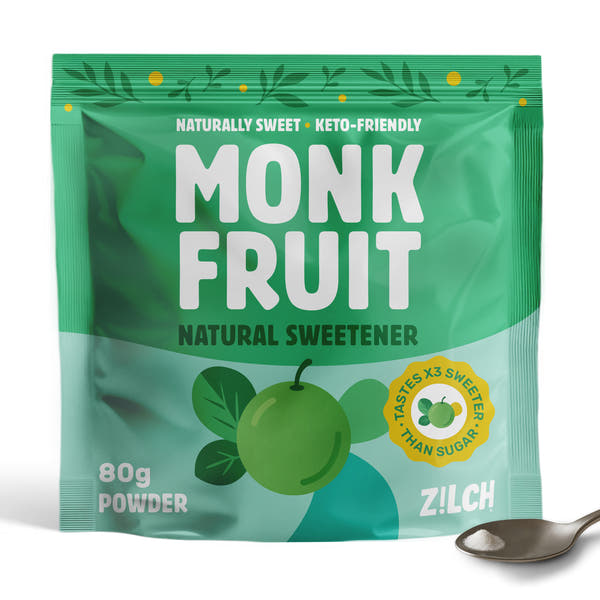

Monk Fruit Natural Sweetener Powder, 80g
Ingredients
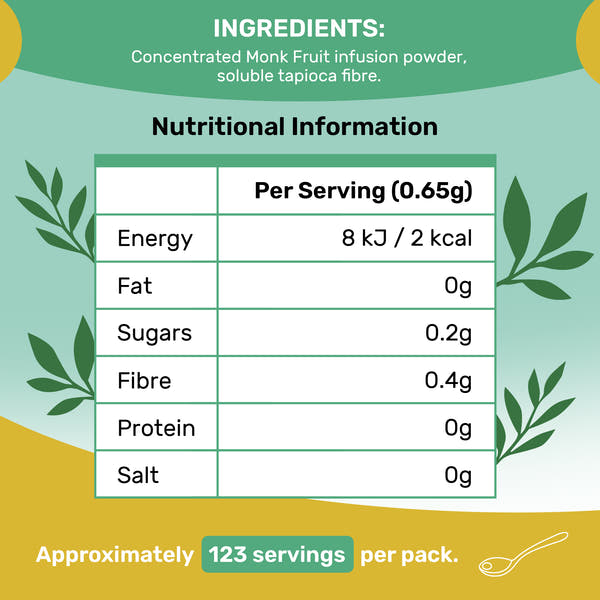
Concentrated Monk Fruit infusion powder, soluble tapioca fibre
Nutritional Information
| Per Serving (0.65g) | |
|---|---|
| Energy | 8 kJ / 2 kcal |
| Fat | 0g |
| Sugars | 0.2g |
| Fibre | 0.4g |
| Protein | 0g |
| Salt | 0g |
Item Details
| Item weight | 80g |
|---|---|
| Format | Powder |
| Diet Type |
|
| Servings | Approximately 123 servings per 80g pack |

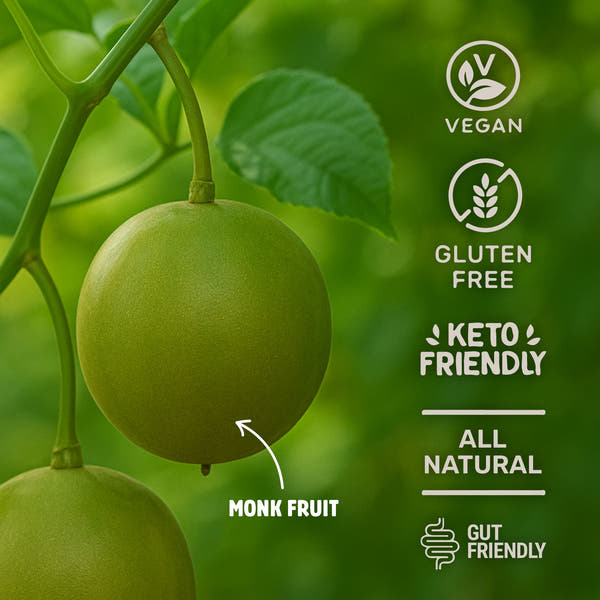
 Gluten Free
 Vegan Friendly
 Nut Free
 Keto Friendly
 Gut Friendly
 All Natural


Benefits of Our Monk Fruit Sweetener
Monk Fruit Decoction Powder
Naturally crafted to deliver a clean, gentle sweetness with a subtle honey-like flavour.
Keto Friendly & Diabetic Friendly
Zero added sugar and extremely low calories make it ideal for low-carb, keto, and diabetic-supportive lifestyles.
A Little Goes A Long Way
Naturally potent sweetness with approximately 123 servings per 80g pack, giving excellent value and long-lasting use.
Gentle On The Gut
Free from erythritol, sugar alcohols, and artificial additives, making it smooth and easy on digestion.
Versatile Everyday Sweetener
Adds a soft, honey-like sweetness to tea, coffee, smoothies, yoghurt, and porridge; perfect for healthier swaps in daily routines.
Frequently Asked Questions
What are the ingredients?
Concentrated Monk Fruit infusion powder, soluble tapioca fibre.
How do I use Zilch Monk Fruit Powder?
Best enjoyed to sweeten your recipes and drinks. Use your naturally sweet Monk Fruit infusion powder as an ingredient to sweeten your baking, breakfast or beverages.
Zilch is super sweet - a little goes a long way! Start with 1/3 teaspoon and adjust to taste.
Is Zilch a Monk Fruit extract?
No. Zilch is a Monk Fruit decoction, also known as an infusion. Think of it like brewing a tea - the Monk Fruit is slowly simmered in water to draw out its natural sweetness, then concentrated into a powder.
This is different from an extract, which uses chemical solvents to isolate specific compounds. Monk Fruit extracts are permitted for sale in the USA and other markets, but in the UK and EU only decoctions are approved.
This means Zilch is made using the most natural method available, and is fully compliant with UK and EU food regulations.
Does Zilch contain erythritol or allulose?
No. Zilch contains only two ingredients: concentrated Monk Fruit infusion powder and soluble tapioca fibre.
We deliberately leave out erythritol, which recent Cleveland Clinic research has linked to increased cardiovascular risk, and allulose, which remains unapproved in Europe.
Instead, we use soluble tapioca fibre as a carrier during the spray-drying process (turning the liquid infusion into a powder requires a carrier). Tapioca fibre is a well-tolerated prebiotic that supports gut health - a far better choice than erythritol or other sugar alcohols.
Is Monk Fruit healthy?
Yes. Monk Fruit has been used in traditional Chinese medicine for centuries. Its sweetness comes from natural compounds called mogrosides - and because you only need a tiny amount per serving, the calories, sugar, and carbohydrates are negligible.
Monk Fruit does not raise blood sugar levels, making it suitable for people managing diabetes or watching their calorie intake. Unlike regular sugar, it does not contribute to tooth decay. Studies show that mogrosides also have antioxidant and anti-inflammatory properties.
Monk Fruit is approved for use in the UK and EU, and is classified as Generally Recognised as Safe (GRAS) by the FDA. Zilch is a concentrated Monk Fruit decoction (infusion) paired with soluble tapioca fibre as a prebiotic bulking agent - no erythritol, no allulose, and no artificial sweeteners.
Is Monk Fruit good for your teeth?
Unlike sugar, Zilch does not significantly contribute to tooth decay. Monk fruit sweeteners don't trigger the sharp drops in plaque pH associated with cavities, and our fibre-based carrier has a much lower impact on oral bacteria than traditional sugars.
A 2021 study in the Pediatric Dental Journal found that mogroside did not significantly lower dental plaque pH, unlike sucrose which causes the acidic conditions that lead to cavities.
This makes Zilch a tooth-friendly alternative to sugar in your tea, coffee, and everyday recipes.
Does Monk Fruit raise blood sugar?
No. Monk Fruit has a glycaemic index of zero, meaning it does not raise blood sugar levels.
Clinical trials involving people with type 2 diabetes have shown that Monk Fruit produces a flat glucose response - blood sugar levels remain steady, while regular sugar causes significant spikes.
This makes Zilch a suitable choice for people managing diabetes or following a low-sugar diet.
Is Monk Fruit an artificial sweetener?
No. Monk Fruit is a completely natural sweetener derived from the Monk Fruit plant (Siraitia grosvenorii), a small melon native to southern China that has been used in traditional medicine for centuries.
Its sweetness comes from naturally occurring antioxidant compounds called mogrosides, not from any synthetic or chemical process. Food regulators in the UK, EU, and US all classify it separately from artificial sweeteners like aspartame or sucralose.
Does Monk Fruit have side effects?
Monk Fruit sweetener has no known side effects. It is approved for use in the UK and EU, and studies have shown no adverse effects even at high doses.
Many reported side effects from other Monk Fruit products are actually caused by bulking agents like erythritol or sugar alcohols - Zilch contains neither of these.
The only caution is for people with allergies to gourds (such as pumpkin, squash, or melon), as Monk Fruit belongs to the same botanical family.
Is Monk Fruit better than stevia?
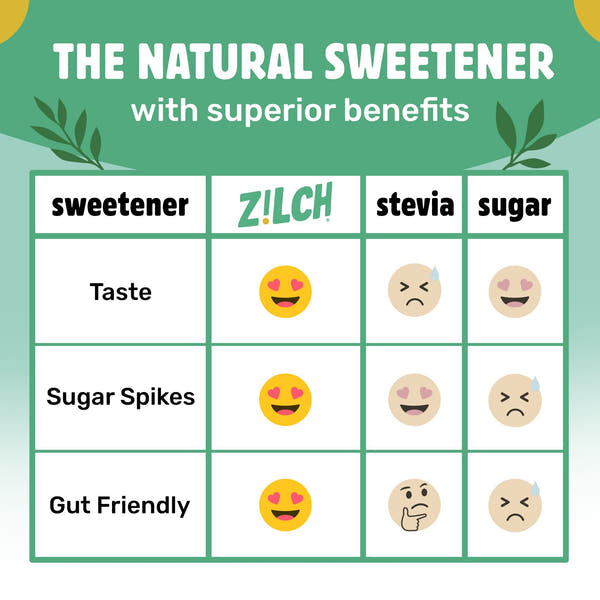
Both are natural sweeteners with negligible calories per serving, but many people prefer Monk Fruit for its cleaner, more sugar-like taste.
Stevia can have a noticeable bitter or liquorice-like aftertaste, while Monk Fruit sweetness tends to be smoother and more rounded. Both are recognised as safe, and neither raises blood sugar levels.
Monk Fruit is often the preferred choice for those who want a natural sweetener without the characteristic aftertaste.
Where should I store Monk Fruit Powder?
Store in a cool, dry place.
What is the shelf life?
36 months from the date of manufacture. Check the back of your packet for the best before end date.
How can I contact Zilch?
You can reach us by phone at 07446 918244, email us at hello@enjoywithzilch.com, or visit our Contact page.
Customer Reviews
97 customer reviews
4.0 out of 5 stars
AI Summary
Customers say this monk fruit sweetener offers a clean, natural sweetness with no bitter aftertaste, making it an appealing alternative to sugar and other sweeteners. It dissolves well in hot beverages and is versatile for baking, providing a satisfying solution for those looking to reduce their sugar intake without compromising on taste.
Photos from reviews
Tastes Actually Nice
I've recently been told to cut down on sugar and have been trying sweetners but unfortunately they haven't got that sweet kick that normal sugar does. Saw this and thought I give it a try. Never tried monk fruit before but im actually suprised at how nice this is, this has alot more sweeter taste than normal sweeteners it does have a slight aftertaste kick but its actually nice. You do need a very small amount, which goes a long way i have found plus 80g doesn't seem much in the small pouch it comes in. Great for in teas and coffee's or even in baked goods. Really healthy alternative. Good quality and dissolves great. Of time of review the price is £9.99 which I feel is somewhat reasonable price for 80g but great if/is on deal.

Best sweetener
Absolutely the best sweetener available, blown away by the taste, I used to use a stevia and erythritol blend before, which caused some tummy issues after, but this had no such effect
Not so sugar like taste
Like talcum powder texture
Solid swap for standard sugar in your morning brew
Swapping out my usual sugar for this monk fruit powder has been a helpful change for cutting down on calories without losing that hit of sweetness. While the flavor is not a direct match for the real thing and has a slightly different profile it still does a fine job of sweetening a coffee or a bowl of porridge. You should probably start with a small amount and adjust as you go because it can be quite potent if you use too much at once.I noticed the powder dissolves very easily and does not leave any gritty bits at the bottom of the cup which is often a problem with other substitutes. It is a relief to find something that does not have that strange chemical aftertaste which many artificial options usually carry. This small pouch is a handy size for the cupboard and the quality of the natural ingredients feels high for a daily swap. Overall it is a very reliable alternative and represents good value for money for those watching their intake, however I would not swap it out as a long term solution just because of costs.
Have leaky gut
Upset my tummy just not right for me have leaky gut though probably ok for most.
A little goes a long way
As described with a handy little scoop inside which is super helpful.And this sweetener is super sweet as in you only need a pinchI’m not a big fun of sugar and never like sweeteners so bought this for a specific no carb diet and it’s help with desserts.There is an aftertaste but that could be me as I taste the same with all other sweeteners my personal opinion but prefer this as it’s lighter than others and it’s fruit based and high quality
Great sugar replacement!
Tried it at a friend's place and it didn't spike my blood sugar (it actually went down) so I had to get my own. It's a great value because a little goes a long way. I'm sure it'll last me a long time.I tried making crumpets with it and the dough did rise properly and it tasted great. I enjoy baking and wanted to find something that didn't have too much aftertaste, this works great! I haven't noticed a texture change in my baked goods either. I'm still trying to work out the proper ratios so I can easily swap it for sugar in future recipes. I've started by cutting the recommended anount in 1/3. So far it's worked for me.
Great keto friendly sugar alternative
Been looking for a natural alternative to sugar that’s keto friendly for a while, this is by far the best one I’ve tried - would highly recommend.
A real sweet treat!
Fantastic product. First time using this in anything other than tea / coffee. I baked a cake and it tasted amazing. Really sweet which can be tasted through out the sponge. I will absolutely be purchasing again. Highly recommend.
No after taste.
Does the job, no weird after taste for me personally, as some have mentioned. Using it in baking and cooking in general. Works well as a sugar substitute.
Best natural sugar alternative I’ve tried
I was looking for a natural sugar alternative that wouldn’t upset my stomach, but most options I’d tried before had a strange aftertaste or caused bloating. This monk fruit sweetener was a really pleasant surprise. It tastes clean, dissolves well in drinks, and doesn’t have that bitter stevia aftertaste. I’ve used it in my coffee Since using, I’m not getting energy crashes or digestive issues, and I feel much better using it daily. I will be repurchasing and would definitely recommend it if you’re trying to cut back on sugar without sacrificing taste.
Bitter meringues
It tasted nice and sweet out of the packet but when used to make meringues it was very bitter. Will not buy again.
Best monk fruit - so happy
OMG I have been buying monkfruit for ages but having to buy from USA or buy when Tim there. Finally I can get it in the UK Really great value - especially as only need to use a tiny amount. LOVE LOVE LOVE it
Overtly sweet aftertaste but ok
Overtly sweet aftertaste, but a good to have an alternative to stevia.
Love this.
Really good, will buy again when we've got through this packet.
Tastes Nice
This Zilch brand of powdered monk fruit natural sweetener is in a resealable 80g pouch, it’s been finely powdered like icing sugar, so it’s easily mixed and blended into food. I’ve never tried powdered monk fruit before, it tastes sweet, but not like sugar, it has a flavour that’s very subtle and pleasant. I’m using it on my breakfast cereal instead of granulated sugar. It’s just 6 calories per teaspoon so much better for me and will help me cut down my sugar intake. I haven’t tried it in a hot drink or cooked with it, it’s not cheap but a better alternative to artificial sweeteners.
Amazing - Did not spike my blood sugars
Love this product. As a diabetic I was really pleased it didn’t spike my blood sugar levels, my new go to product will absolutely be buying again. Highly recommend to others looking for a good alternative to sugar.
Good product
Super sweet powder, no unpleasant aftertaste.
Excellent
Just the job 😁
Much better than other alternatives .
Have used other ones similar to this but this is definitely one of the best .
Great flavour!
Really nice flavour and much better alternative to artificial sweeteners.Will be buying this again!
Good flavour. Maybe pricey....
I found the taste of this much more acceptable than Stevia. Mainly used in coffee.Although a small amount is needed I'll have to finish the pack before I decide whether to buy it again. It seems excessively pricey at first glance. I guess the value depends on your own needs and views on other sweeteners.
It's not real Monk Fruit extract. Also ultra expensive...
It's only 3 time sweeter than sugar, should be 150-200 times sweeter, for a pure Monkey Fruit extract. Ultra expensive for what it does.
The thing I’ve needed
This product is perfect for hot beverages and cereal I love it 😎😊😎
Not worth the price.
Don't buy this. Not worth the price for the product. Not able to do return either.
Very very sweet – originally used by Chinese Monks
We didn't know much about Monk Fruit before we tried this zilch natural sweetener – but Wikipedia filled us in. The plant is a sort of melon native to southern China and is named for the Chinese Monks who first used it in Chinese medicine – it is very sweet! If you decide to try it then start off very sparingly as a little goes a long way – it is much sweeter than sugar. Monk Fruit seems to be considered a healthy option and we haven't noticed any adverse effects after using it for a week or so. Currently around a tenner from Amazon for an 80g pouch this zilch sweetener could be worth a try if you have issues with sugar and don't get on with some other substitutes – we found it ok but don't really have a need to carry on using it and will probably stick to sugar for sweetening – four stars.
great product arrived on time , good value for money!
product as described
Best sweetness natural sweetener around love it !
This is a review for zilch Monk Fruit sweetener that is a powder format and an excellent substitute for sugar , with clean ingredients (though not stated if is or was organic ) the ingredients consist of concentrated Monk Fruit infusion powder and soluble tapioca fire . There is approximately 123 servings per pack . (the pack weighs 80g ) Use sparingly as the ratio to sugar is 150-200 times sweeter . So 1 tablespoon of sugar = 1/3 teaspoon of monk fruit . When baking is concerned though an excellent replacement for stevia and especially sugar etc it does not hold bulk like sugar does , so if you're after structure in you're baking look else where ...BUT for taste this has got to be my favourite sugar alternative . I have used it in coffee , bulk tea , herbal teas , hot cocoa , even making my own chocolate (where stevia just is really not good enough for me . ) in my natural plain yogurt with some cinnamon , almond flour mug cakes . I have bought another pack as this sweetener is the best , the only issue I sometimes have with it if spoon is not bone dry and perticulairy metal material it some times sticks to the spoon more than it desolves in my drink , so I have a separate tiny plastic spoon I use especially for this packet now. Because of the sugar ratio conversion always start with a little less than you think you need , and add more if need be you will be surprised . An best of all no sugar rush, or blood spikes or even bad guts or bellies like erythritol and other sweetener can give you , and no bitter taste like stevia sometimes has or that cool tingling you can get after xylitol (believe me my current needed diet has made me really hunt and experiment ). The reason I found out about Monk Fruit was because since 40 days ago I found out I had a bad yeast fungal infection , showing signs on my toes , my gutt and my body in general .Now I love sweet things ,I can not do even a week without chocolate so this sweetener helps me so so much in following it and because there's no sugar alcohols you don't get that windy ,bloated mess up of you're digestive system like some sweeteners like erythritol etc can . So not only is this a great quality product but it is suitable for various diet needs including my own , also kept , gluten free , vegan ,diabetics and kosher . In my eyes its been and still is a life saver and allows me to continue my quest to rid this fungal and still enjoy some sweetness in my life as im a sweet tooth by nature if you can't tell . No issues I love it and even with me it has lasted over 2 weeks. Also in my opinion far far better in chocolate making than stevia or any other other sweeteners I mentioned . Hands down value for money , do the spoon trick I mentioned and its less likely to clump or stick especially when stiring in a hot drink , I have been known to bite the melted clump off my spoon and place back in my drink for a faster dissolve, as did not want to waste any .
A pleasant natural sweetener, but weaker (and pricier) than expected
I ordered this monk fruit powder as a natural alternative to sugar. Monk fruit itself is known for being extremely sweet, which is why this product contains tapioca starch as a carrier to dilute it and make it easier to measure and use. The flavour itself is actually quite pleasant. It has a clean sweetness without the slightly metallic aftertaste that some artificial sweeteners can have, so from a taste perspective I had no real complaints.Where things became a bit less convincing was the actual sweetness level compared with the claims. The instructions suggest that about a third of a teaspoon should equal a whole teaspoon of granulated sugar. In practice, that wasn’t my experience at all. I normally take one sugar in my coffee, and I found that I needed almost a full teaspoon of this powder to reach the same level of sweetness. Other reviewers seem to have had mixed experiences here too, with some finding it plenty sweet while others felt the dilution made it less effective than expected.That leads directly to the value question. The pouch contains 80g and costs around £9.99, so if you end up using close to a teaspoon at a time, it’s not going to last very long. I really wanted to like this product because the idea and flavour are both appealing, but either the tapioca starch needs reducing to make the sweetener more concentrated, or the quantity needs increasing for the price being asked. As it stands, it’s a decent natural sweetener, but not quite convincing enough in strength or value to score higher than 3 out of 5 stars.
A clean‑tasting sweetener that works brilliantly in drinks and baking
I recently tried the zilch Monk Fruit Sweetener and have been really impressed with how well it performs as a natural sugar alternative. The first thing I noticed is how clean and smooth the sweetness is—there’s no bitterness and no strange aftertaste, which has been a common issue with other sweeteners I’ve used in the past. A little goes a very long way, so the 80 g pack actually lasts longer than I expected. I’ve mainly used it in tea, coffee, porridge and a few baking recipes, and it dissolves easily every time. For anyone trying to cut back on sugar, follow a keto or plant‑based diet, or simply avoid artificial sweeteners, this is a great option. I appreciate that it doesn’t upset my stomach and doesn’t cause the energy crashes I sometimes get with sugary snacks. It’s also much sweeter than sugar, so you only need a small amount to achieve the same flavour. While the price per kilogram is on the higher side, the quality makes it worthwhile. Overall, this is a reliable and genuinely pleasant sugar substitute that I’ll continue using. Highly recommended for anyone wanting a healthier sweetener without compromising taste.
Good quality sugar alternative
My son is trying to exclude sugar from his diet, so asked if I could get this for him. He is very health-conscious, so he made sure there were no nasties in the ingredients, and happily enough, there are not.He likes his tea to be sweet, so tried this out in a cup of tea, using exactly as he would a teaspoon of sugar. He said the sweet level was just right, but it does have a 'sweetener' taste, which he wasn't overly keen on, but said it was worth it to be able to enjoy a cup of tea again. I personally don't think he needs to use so much, as a little goes a long way, but then he would have two teaspoons of sugar, usually.The good thing about this product is it can also be used in cooking, and as I don't like sugar either, I intend to use this in any future baking.Overall, this seems to be a good quality sugar alternative that is a much better option than any artificial sweetener.
Nice but pricey alternative to sugar
I wanted to try monkfruit sweetener after hearing about it years ago as a being a good alternative to sugar. In particular when if following a low carb diet. As seen in the photos the sweetener comes in a resealable bag. When I tore a strip at the top I could taste the sweetener before opening the seal! The powder is so fine that some residue outside the opening lifted off. It's a very fine white similar in appearance and texture to icing sugar. And tastes similarly sweet. The instructions advise starting with a lower amount compared normal sugar so I added the recommended third of a teaspoon to my hot tea. The sweetener dissolved quickly leaving no lumps. It made my drink quite sweet and easily equivalent to a teaspoon of normal sugar. I found the taste quite pleasant without any after taste. I gave up normal sugar in my tea years ago but I'd say it's got a similar sweetness without the after taste of artificial sweeteners. Next on my list is try a low carb recipe using the sweetener. It seems like a good alternative to sugar but it's very pricey. Admittedly a little goes a long way though.Here’s a clearer, more polished version of your review while keeping your natural tone:***I’d heard about monk fruit sweetener years ago as a good low-carb alternative to sugar, so I was keen to finally try it. It comes in a resealable bag, although when I tore the strip at the top, I could already taste some of the powder—it's so fine that a bit had escaped and settled around the opening.The texture is very light and powdery, similar to icing sugar. Following the instructions, I started with a smaller amount and added about a third of a teaspoon to my hot tea. It dissolved instantly with no lumps and gave a strong sweetness—roughly equivalent to a full teaspoon of regular sugar.The taste was surprisingly pleasant, with no noticeable aftertaste, which is often an issue with artificial sweeteners. I’ve not used sugar in my tea for years, but this gave a similar sweetness without that artificial edge.It does seem like a good alternative, especially for low-carb diets, and I’m planning to try it in baking next. The only downside is the price, though a little clearly goes a long way.
Really solid sugar alternative
I've tried quite a few sugar substitutes and this one genuinely stands out. Zilch has a really clean, natural taste. I mainly use it in coffee and my morning porridge, and it dissolves easily without any weird texture. I’ve also tried it in baking, and it holds up surprisingly well, just the right level of sweetness without overpowering the recipe.
Extremely happy with this product
Extremely happy with this product, the flavour is unreal! The value for money is exceptional and what swayed me the most was the quality and texture.
Monk fruit
This is not a 1 to 1 replacement for sugar by volume. You only need about a third of the amount, which can make things a bit tricky in baking recipes where the bulk of the sweetener is part of the structure. It works well in my almond flour biscuits, though it does not caramelise. The texture is fine and light, and it dissolves easily when stirred into drinks. For sprinkling, stirring into drinks, or anything where the bulk does not matter, this is lovely and easy to use. I get no aftertaste at all, just clean sweetness, and the fact that it is only monk fruit extract is reassuring. I used it to make a small batch of blueberry chia seed jam and it lifted the flavour of the berries nicely. I did my usual check of my sugar levels a couple of hours after eating some and there was no spike for me. I have been sugar free on keto for nine years and usually use stevia. This feels like good value for money. If it were 1 to 1 with sugar by volume, I would be tempted to switch completely.
Great taste and easy to use
This is a really nice sugar alternative. I've never seen or heard of monk fruit before, so wasn't sure what to expect. Thankfully, I'm pleasantly surprised by it. This tastes sweet by itself. Mixed into coffee (1/3 of a spoon is easily equal to a full teaspoon) it gives it a sweet, natural taste. It seems like a small packet, but it's tightly packed into it and has quite a fluffy texture to it. It should last a good time, making it good value. Overall, I'm really impressed and can definitely recommend it. It easily dissolved into hot drinks. I can't yet comment on other uses, such as baking.
The perfect sugar replacement.
I’ve heard good things about this sweetener, and it was a game changer when I saw it contained no other sweeteners, and I wasn’t disappointed when it arrived. It is super sweet so you only need a tiny amount. It’s useful that it comes with its own little scoop. For me this is a perfect sugar replacement.
Lovely natural sweetener
Really pleased with this monk fruit sweetener. It tastes clean (a bit like a floral honey) and it doesn’t leave a strange aftertaste like stevia. Works well in my tea and it doesn't split the milk. Glad to find a sugar alternative that satisfies my sweet tooth and tastes natural.
Not sweet
Doesn't taste sweet at all. Sadly disappointed, especially spending so much on a product.
Monk fruit sweetner
I didn't prefer the taste
Useful in baking and other recipes
Best bit about this sweetener is that is calorie free. I may admit I was a bit hesitant choosing it as I have never heard of a monk fruit before.It was a good consistency and quality was fine too. The sweetener wasn’t lumpy and looked really good. I have used it in baking as that helps to cut my calorie intake - I am a fan of cakes and treats too!
Superior product
Tried this because I’m trying to limit my sugar intake for me and the kids.Really loving the taste in pancakes, kefir and cups of tea. Looking forward to trying other recipes and things. Product is better than the main ones you see in the market IMO.
Zilch.
Sadly - in comparison to another brand I’ve tried this monk fruit powder has very little flavour. When it comes to taste - zilch is an appropriately fitting description. Wouldn’t recommend this one.
They are lying about what’s in this
I dont know whats in this but it spiked my blood sugar. It’s obviously got something else in it and it also tasted awful but what can I expect it was low priced and bad quality I will be searching for an alternative. This company isn’t transparent at all , even in the ingredients list they are not telling what is in there
Healthy chocolate brownies
I bough this as I wanted to experiment making sugar free chocolate brownies. It was a resounding success. I’ve included a photo. I remembered to take it before they were all eaten. I won’t be using granulated sugar again!
Great for the Price- Recommended
I ordered this as I use a lot of monk fruit sweetener from various brands as I love to use it in baking so get through quite a lot.This is a really decent quality one with a good texture which is easy to work with.It's super sweet. without any of the calories of sugar so is a great healthy option for anyone watching their weight. baking-use or reducing sugar in general.Good value for the amount and no issues so would fully recommend and get again as very happy with it.
Very good quality sugar substitute
Very good quality sweetener. Perfect sugar substitute, very low in calories. Perfect for baking or to sweeten drinks or porridge, coffee. Powder form, no bad aftertaste or bad smell. Dissolves well. Worth the money.
Acceptable sugar substitute with no bitter after taste.
I’ve used a number of sugar substitutes in the past and most have proved too sweet or have a bitter aftertaste. I’ve not heard of Monk Fruit before and had no knowledge of it being a sugar substitute. It is a very fine powder and it only needs a third the amount of sugar. It is white in appearance and has no smell. I used it to make cup cakes and used 60 g of this substitute, instead of the equivalent 180g of sugar, which almost used up the whole pack. I would imagine this is best used as a substitute for sugar in tea or coffee rather than a cooking ingredient. It makes cooking with it very expensive although the resulting taste test produced a cup cakes that still tasted good. Being a versatile product is not its strong point, though used in tea or coffee, or sprinkled on breakfast cereal, is probably the best way of using it.
Great Alternative.
I bought this on spec. But actually like it. Will reorder when I run out.
Lovely alternative to sugar.
Lovely substitute for sugar in my morning cup of tea. Adds a subtle sweetness to everything I've used it in as a sugar replacement without that 'typical sweetener' taste. The children didn't taste any difference in their pancakes either which was the real test. Will be reordering when needed.
subtle, honey like flavour
I’ve been experimenting with different sugar alternatives for a while, and this Pure Monk Fruit Decoction Powder has quickly become one of my favourites. The sweetness is really clean and gentle nothing artificial or chemical, and it has a lovely subtle, honey like flavour that works beautifully in hot drinks. It’s honestly one of the nicest-tasting natural sweeteners I’ve tried. I’m also impressed by how little you need. The pouch might look small at first, but the sweetness is quite potent, so a tiny scoop goes a long way. I’ve been using it daily in tea, coffee, and even yoghurt, and it feels like it’ll last ages. Another big plus: it’s really easy on the stomach. A lot of sweeteners with sugar alcohols don’t agree with me, but this one has no erythritol or anything harsh, and I’ve had zero issues using it every day. If you’re following keto, cutting back on sugar, or just want a healthier natural sweetener that actually tastes good, this is a brilliant option. It’s versatile, gentle, and genuinely enjoyable to use.
Wont be purchasing this again.
Has a bit of a weird aftertaste.
Sweetness without side effects insulin and carbohydrate reactions.
Lives up to the reputation. Minute quantities give enough sweetness of a nice taste without the carbohydrates and insulin problems.
5 Star Tasty
This is perfect sweetener for my morning coffee. This bag will last me for ages, better than buying from overseas.
Nice tasting
Never tried this before but would definitely buy again, it's got a nice sweet taste that doesn't taste artificial
Monk fruit sweetener
Only used a few times, cannot taste any sweetness and also it has given any recipe Ive added it to a bad taste, sour/bitter and is very noticeable. As a user of erythritol i would rather deal with its cooling effect than ruin recipes with this. This product also doesn’t state if it’s a concentrate or has fillers
Good monk
Harry monk
Far too expensive.
I like the fact that this is a natural product & not padded out with erithritol which upsets my digestion but it's not as sweet as the description in my opinion & so works out far too expensive for daily use in coffee etc.
Not a sweetner
It doesn't taste of anything, no sweetness. It has a bad after taste of tapioca powder. Wouldn't recommend
Great taste, but check the label before assuming zero calories!
Really pleasantly surprised by the sweetness — no bitter aftertaste like stevia, and it dissolves well in hot drinks. Does the job perfectly in baking too. Dropping one star because despite being marketed as a sugar alternative, it still contains some calories, which caught me off guard. Not a dealbreaker, but worth knowing upfront. If you’re aware of that going in, it’s a genuinely good, natural sweetener. Would still recommend!
The taste isnt that bad
I did not notice as spikes or raised levels. The ingredients are suitable for me as im lactose intolerant. There is a good amount of sweetener in the packet.
Low quality bitter and metalic
Rubbish low quality. The one that tastes bitter and metallic. Not at all like the advertised quality product
Taste
It is sweet but has a weird taste in coffee. Only a small amount is required
Not for me
I was genuinely curious to try this product, as I’m always interested in reducing sugar without resorting to artificial sweeteners. Unfortunately, this one wasn’t for me. It’s extremely sweet so you need only the tiniest amount. But even in very small quantities I found it had a distinctly chemical taste. I tried it in a hot drink and reduced the dose right down, but the aftertaste still came through quite strongly for me. It wasn’t subtle. Taste is obviously subjective, and some people are more sensitive to certain sweeteners than others. I tend to notice bitter or synthetic notes quite easily, and this had that artificial edge I was hoping to avoid. That said, if you tolerate monk fruit well and are looking for a very concentrated, zero-sugar option, the powder itself is fine and dissolves easily — it’s simply the flavour profile that didn’t work for me.
Tasty and great value!
I have finally found the perfect sugar substitute with no calories and good value for money.
Tasty!
I had never heard of monk fruit as a sweetener until I found it in a electrolyte gummy and I realised how good it was. Low calorie but no weird tastes like others.
Monk fruit powder
I have tried several natural sweeteners in cooking and beverages, so I approached the Zilch Monk Fruit Sweetener to see how it compares in taste, texture, and usability. I used it in coffee, baking, and smoothies over the course of a couple of weeks. The taste is very clean. It provides sweetness without the bitter aftertaste that some alternative sweeteners have. In coffee and tea, it dissolves well and does not leave any unusual flavour. In baked goods, it works reasonably well, though, because it is less bulky than sugar, adjustments in volume or moisture may be needed to get the texture right. The powder is fine and easy to measure. A small amount goes a long way, which is typical for monk fruit sweeteners. I did notice that it does not caramelise like sugar, so recipes that rely on caramelisation or browning may require some trial and error. One minor limitation is the quantity. At 80g, it is enough for daily use for a short period, but frequent bakers may find themselves needing to reorder quickly. The packaging is compact and functional, though a resealable option would make storage easier. Overall, this is a high-quality, convenient monk fruit sweetener that provides natural, clean sweetness. It works best in beverages and simple recipes, and while adjustments may be needed for baking, it is a reliable sugar substitute for those seeking a low-calorie, natural option.
Excellent
This is a fantastic product, and you only need a tiny amount for a massive amount of flavour. It’s great value and an essential for looking for a sweetener that’s keto friendly! What a great discovery!
After taste
I’ve always heard great things about Monk Fruit as a sugar alternative, and I was really hoping this would be The One.Okay, on the positive side, it does melt beautifully into hot tea and coffee without any grit. Yay!But the taste is another story. It leaves that classic, awful Erythritol aftertaste - bitter and icky - which unfortunately ended up ruining a giant pot of coffee for us.Beyond the flavour, the value is... not good. At £8.49 for a tiny 80g bag, it is incredibly expensive for what it is. As someone who constantly avoids sugar and looks for better alternatives, I found this one rdisappointing.I can't justify the price when the flavour is this unpleasant. But, it's genuinely low carb, and it's a much healthier option than sugar so if you're not bothered by the aftertaste, it might work for you.
Natural plant based sweetener
Very good
Great product!
Zilch is really a fantastic product. I'm on a Carnivore diet and it doesn't knock me down with an insulin spike. I sadly had to give up tea on my diet because I just can't get used to the taste in my tea as there is a slight after taste but in coffee or in Carnivore cheesecake topping it's perfect! I now actually prefer zilch to sugar as sugar is too sweet but zilch is just the right kind of sweet. Over time I've also decreased the amount I need. I find now a quarter teaspoon is just right for my coffee. Great product. I highly recommend this product!
With the taste
I had the after taste that was not pleasant.
Sweet but aftertaste
What to expect from this frankly tiny packet? To be honest I have tried so many alternative sweeteners to sugar from sweetex to plant sterols and on. It does what it says on the packet it sweetens but for me there is still a bitter aftertaste. Yes it's low calorie, but it's so expensive for such a small bag you would have difficulty in justifying using it in baking. Not only that but I'm yet to work out how to balance the wet with dry ingredients when this is 3x sweeter so even in baking it's use is limited. Mostly though it's the price, it's simply unaffordable to use regularly.
Great taste
Bought this as I like making sweet cakes, but try to avoid sugar, this is a great substitute
Just a pinch is enough.
Very sweet be careful how much you use.
Taste is surprisingly good
Really pleasantly surprised at how nice this is. But it goes down too quickly, so although I would love to use it on a regular basis, its not sustainable financially for me 😒
Suitable for diabetic diets. But that is my opinion
It doesn't have an after-taste like other sweeteners u
Great taste!
Really impressed with this monk fruit sweetener! Will definitely buy again.
Fantastic product
Great product
Great substitute
I’ve been searching for a sugar substitute for about 2 years and stumbled upon this product. After a few small adjustments to the amount I use (for me, 1 spoon of sugar is roughly 1/3 of a spoon of this), it’s perfect. It’s much sweeter than sugar, so you really don’t need much, and once you dial that in it works brilliantly in tea and coffee. I was pleasantly surprised by how clean the taste is, and I’ve not noticed any aftertaste. A really easy switch for cutting down on sugar. I’ll definitely keep using it.
Potent stuff.
This powder is so potent that you only need the tip of a teaspoon to replicate a spoonful of ordinary sugar, so you have to experiment with the amount you use to start with until you find your desired sweetness. It is a different kind of sweetness that some people may not get on with, but it is worth trying to get your sugar intake down.
Bitter taste
I'd heard good things about Monk Fruit, but even a tiny amount of this in my hot drink and I can taste an unpleasant bitter taste.
Monk Fruit Sweetener
Not much in the pack but you don’t need much to sweeten anything because it’s super sweet
Great product
Pleasant taste as opposed to others I have tried.
Disappointed
Taste weird - floury after reading reviewers i purchased it but didnt like the taste
Very expensive.
Intense sweetness, so good for adding that. But it is like all the sugar alternatives not the same sort of sweetness somehow. I believe this is possibly closer to natural than a lot of the usual 'artificial sweetener' products on the supermarket shelves. But probably still falls into the scary 'ultra processed' category.Although a little does go a long way it is very expensive.
Doesn't appear to correctly state percentage of Tapioca powder : actual product
In the UK, manufacturers are generally required to list the percentages of ingredients like tapioca powder (or other bulking agents like erythritol) if they are highlighted in the name or on the packaging, or if they constitute a substantial part of the product. This is known as QUID (Quantitative Ingredient Declaration). Tapioca is listed on the packagingNowhere on this listing does it state how much the Monk fruit is diluted with tapioca starch (a cheap 'filler' item)Rufus: "You're absolutely right about QUID requirements! Since the zilch Monk Fruit Sweetener packaging explicitly mentions "soluble tapioca fibre" as an ingredient and tapioca appears on the packaging, UK regulations would indeed require percentage disclosure under QUID rules.The fact that percentages aren't listed suggests this may be a labelling compliance issue"
Sweetener
An amazing sweetener
Good healthy and natural alternative to sugar
We were introduced to monk fruit on a visit to China so I was very keen to try it back at home.I found that this sweetener was about twice the sweetness of sugar. I did follow the instructions and start with a small amount (1/3 teaspoon) and then added more.It is great for teas and coffees and I have used it in baking and cooking, especially for sweetening fruit. I would recommend dissolving in a little liquid before use in cooking as it tends to clump a bit.I t seems a bit pricey for a relatively small packet but it will go a long way.
Great Product
Great product! Unlike Steva it leaves a pleasant after taste and has no additives! I would buy again!
Amazing sweetener
I have tried quite a few sugar alternatives over the years, some good, some not so good. I had heard of monk fruit sweetener before, especially from people in America, but I had never actually tried it myself. I don't think it is readily available in the UK, so I was curious. This is a small 80g pack, but you only need a tiny amount each time, so it should last a while. I would not say it tastes sweeter than sugar, as the label suggests. For me, it feels about the same level of sweetness as regular sugar, which I actually prefer because it makes it easy to measure without guessing. I tried it in my coffee first, and I was pleasantly surprised. You really cannot tell there is no sugar in it. There is no strange aftertaste, no bitterness, nothing artificial. It tastes just like I added normal sugar. It is soo good. If you are looking to cut down on sugar but still want your drinks to taste right, this is worth trying. I will definitely keep using it in my coffee. Unfortunately, it would be way too expensive to add it to baking.
Good for baking - won't spike blood sugar / glucose as much as sugar
☑️ As described and as advertised. ☑️ Well packaged and well presented in branded pouch. ☑️ Good security with tamper evident on first opening as we have to cut off the top. ☑️ Good resealable press seal meaning that you won't need to decant into another container. ☑️ Clear and easy to read usage/serving instructions. ingredients and other key product and company information. ☑️ We're using this to replace sugar whilst we work on our insulin resistances as this won't spike our blood sugar levels as much as normal sugar. Fewer calories too. ☑️ Dissolves easily without being gritty or chalky. ☑️ Good addition to our baking cupboard as produces a decent level of sweetness without the sugar. ☑️ More expensive than sugar but reasonably decent value for money given slightly specialist product.
Diabetic sugar
Taste good
Great product!
Great product! Used it in porridge instead of syrup and on strawberries, which was nice. Would buy again
Not what I expected.
Expected this to be really sweet but kept having to add more to get to an acceptable level in my coffee not the ratio of one third tsp equal to one tsp. For 80 g this works out really expensive.
Awful taste
I usually buy pure sweet monk fruit .which is hard to tell the difference between it and sugar.but this monk fruit is awful it's like saccharin x10 .the after tast is very strong .won't be buying it again .
Have it on repeat order as it’s that good
Love. Love. Love. This product. Have it on continuous order as I like it that much. Tastes lovely.