
How much monk fruit to use instead of sugar: a UK conversion chart
 By Keith Mander, co-founder of Zilch · 05 November 2026

Your recipe says 100g of caster sugar. With Zilch, start with about 33g, a third of the weight, then taste and adjust. The chart below does the maths for the amounts UK recipes use most. The harder question is what to do about the other 67g, and the answer depends on whether you are making a drink, a bake or a sauce.
The rule of thirds, in brief
- Start with about a third of the sugar's weight in Zilch, because it is around 3x as sweet as sugar. Then taste and adjust.
- In drinks there is nothing else to fix, since sweetness is the only job sugar was doing.
- In bakes you lose two thirds of the sugar's bulk, so weigh on a digital scale and make up some of the gap with yoghurt, fruit purée or ground almonds.
- Monk fruit products that promise a "1:1" swap get there by being mostly a bulking sweetener, usually erythritol.
Why a third, and why by weight?
Zilch is a monk fruit infusion powder (a gentle water infusion of the whole fruit, known technically as a decoction) on a soluble tapioca fibre carrier. Gram for gram it is around three times as sweet as sugar, so a third of the weight gives you roughly the same sweetness.
Weight matters more than volume. A spoonful of Zilch and a spoonful of sugar do not weigh the same, so spoon-for-spoon conversions drift, and the error grows with the recipe. Treat a third as a starting line, not an exact equivalence: your own taste counts for more than any chart.
The conversion chart
A UK household teaspoon of granulated sugar weighs about 4g and a level tablespoon about 12g. The Zilch figures are rounded to the nearest sensible gram.
| Sugar in the recipe | Zilch to start with (by weight) | What to do about the missing bulk |
|---|---|---|
| 1 tsp (about 4g) | about 1.3g | Nothing. Too small for most kitchen scales, so add a little, taste and add more. |
| 1 tbsp (about 12g) | about 4g | Nothing in drinks, porridge or dressings. |
| 25g | about 8g | Usually nothing. In a small sauce or a pan of porridge you will not miss it. |
| 50g | about 17g | In a bake, add about 15 to 20g of natural yoghurt or fruit purée, or accept a slightly denser result. |
| 100g | about 33g | Make up about 35g with yoghurt, mashed banana, apple purée or ground almonds. |
| 150g | 50g | Make up about 50g, and expect a paler, closer crumb. |
| 200g | about 65g | Make up about 65g. At this level sugar is often part of the structure, so a recipe written with less sugar may serve you better. |
| 250g | about 85g | Make up about 85g, or choose a different recipe. Meringues and caramel are best left to sugar. |
Why make up only about half of the gap? Most of the ingredients you would use to fill it, such as yoghurt and fruit purée, bring water that sugar does not. Replacing the full weight tends to give a wet, heavy batter.
Drinks, bakes and sauces need different things
Drinks
Tea, coffee, hot chocolate and smoothies are the easy end. Sugar only sweetens a drink, so there is nothing to compensate for, and the amounts are too small to be worth weighing: add a little Zilch, stir, taste and build up. You will use much less than the sugar you used to take.
A teaspoon of sugar in each mug adds up fast. The NHS advises adults to have no more than 30g of free sugars a day, and four sugared mugs come to about half of that. For cold drinks, dissolve Zilch in a splash of hot water first, since powders dissolve slowly in ice-cold liquid. Our guide to how to use monk fruit sweetener covers more everyday drinks and breakfasts.
Bakes
Here a digital scale that reads in 1g steps is not optional. A heaped spoon versus a level one makes a real difference at these quantities, and you need grams to work out how much bulk to add back.
- Fill the gap with natural yoghurt for muffins and loaf cakes, mashed banana or apple purée where fruit suits the bake, or ground almonds for denser cakes.
- Expect differences. Monk fruit does not caramelise, so bakes come out paler and slightly denser, and they keep for a shorter time.
- Judge doneness with a skewer, not by the colour of the crust.
Our post on baking with monk fruit goes through which bakes adapt well and which to leave alone.
Sauces and dressings
Sharp fruit sauces, vinaigrettes and marinades sit in the middle. The rule of thirds works well, and the missing bulk rarely matters because sugar is a small part of the whole. A cranberry sauce made with 250g of cranberries and 100g of sugar would start with about 33g of Zilch instead.
Two things change. Sugar adds gloss and helps a sauce thicken, so a Zilch version will be looser; simmer it longer, or add a grated apple. Sugar also helps preserve, so keep the sauce in the fridge and eat it within three or four days. Jam, where sugar is both preservative and set, is not a job for Zilch.
Sweetness is personal, so taste as you go
Some people find a third of the sugar's weight plenty; others want a little more, and the answer shifts if you cut back gradually. We look at why reactions vary so much in why monk fruit tastes different for everyone.
- Cold dulls sweetness. Taste chilled desserts after chilling, not before.
- Acidity needs more. Rhubarb, cranberries and lemon will take you towards the top of the range.
- Overdoing it shows. Too much monk fruit can leave a lingering sweetness, so add the last few grams one at a time.
Why do some monk fruit sweeteners say "1:1"?
Because the monk fruit in them is not doing the measuring. Any monk fruit preparation is sweeter than sugar, so a product that swaps spoon for spoon has to be made mostly of something less sweet and bulkier. In most cases that is erythritol, an approved sweetener (E968) that is noticeably less sweet than sugar, with a small amount of monk fruit added to make up the difference.
It genuinely solves the bulk problem. The trade-off is a cooling feel in the mouth and, for some people, digestive discomfort. You can check what you are really buying, because UK rules require ingredients to be listed by weight, from most to least. If erythritol comes first, it is most of the pack. We explain why we left it out in monk fruit without erythritol.
Why choose Zilch for everyday swaps?
We made Zilch concentrated on purpose. It asks you to do a little maths, and to fill the gap yourself in a cake, in return for sweetness without erythritol, sugar alcohols or artificial additives. For coffee, porridge and sharp fruit, the rule of thirds is all you need; for baking, add a scale and this chart.
Related reading from our blog
FAQ
How much Zilch replaces a teaspoon of sugar?
A teaspoon of sugar weighs about 4g, so the equivalent is about 1.3g of Zilch. That is hard to weigh at home, so in a drink add a little, taste and add more until it suits you.
My recipe uses American cups. What do I do?
Convert the sugar to grams first. A US cup of granulated sugar weighs about 200g, so you would start with about 65g of Zilch, then use the chart to deal with the missing bulk.
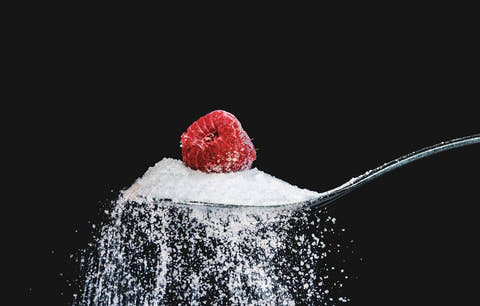
Photo: a bowl of white granulated sugar, by Douglas P Perkins via Wikimedia Commons, licensed under CC BY 3.0.

